
LeBrun's Big Bag Seals Ultimate Angler Championship Title

bass

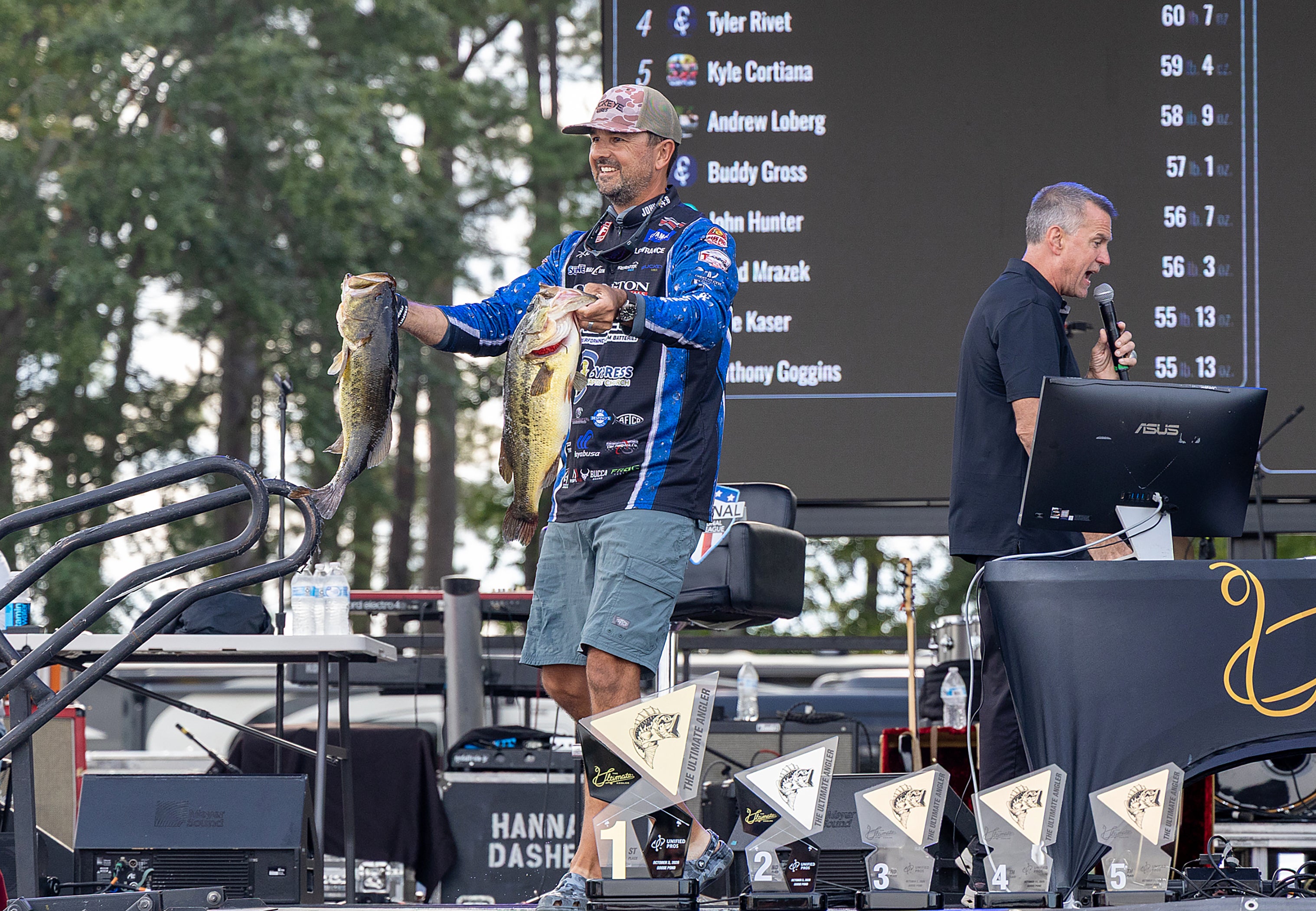
Nick LeBrun weighed in a 28-pound bag to clinch the Ultimate Angler Championship title and the $500,000 top prize. Photo by Kate Stone

By DAVID RAINER, Alabama Department of Conservation and Natural Resources

When Nick LeBrun of Benton, Louisiana, weighed in a whopping 28 pounds of bass Saturday to win the $500,000 top prize at the Ultimate Angler Championship at Lake Guntersville, he credited it to one thing — grass.

Every angler who fished the elite event last weekend talked about the same feature that makes Lake Guntersville one of the top lakes in the nation, and it’s a combination of vegetation that makes it the ideal fishery.

LeBrun said it was the grass mats of hydrilla and milfoil that allowed him to catch his five-fish limit, a monster bag for the fall, on a plastic frog skimmed across the surface of the grass on Alabama’s largest lake at 69,100 acres. 

Veteran Alabama anglers Gerald Swindle and Randy Howell echoed that same sentiment about Guntersville that also was expressed by just about every angler who crossed the stage. The championship was sponsored by the State of Alabama, Alabama Department of Conservation and Natural Resources (ADCNR) and the City of Scottsboro.

“Guntersville has just stayed at the top of the charts,” said Swindle, a two-time Bassmaster Angler of the Year. “It’s easily in the top three lakes in the country, and it’s sustained that ranking for the last 15 years. It’s got everything to do with the grass. We have really healthy grass. Even though they are managing some of it, the fish always have good habitat. The bait has a place to hide so they grow good. It’s fertile, and it just keeps bouncing back, no matter how much pressure it takes. Guntersville is just Guntersville. You catch a lot of fish, and within a couple of weeks, it’s going to blow up, and the fishing will be great.”

In 2014, Howell won the Bassmaster Classic on Lake Guntersville, a Tennessee River lake in northeast Alabama, which makes it even more special to the angler who has called Guntersville home for the past 11 years. During his pro career, he has fished Guntersville for 30 years.

"The only reason Guntersville survives and is a bass factory is because of the grass,” Howell said. “There are just thousands and thousands of acres of healthy, green grass – five or six or seven kinds of grass. That helps the hatch during the spawn survive. The fry hide in there and don’t get eaten by the crappie, bream, gar and everything else. That’s why we have right now a huge class of little bitty fish. There are 10- to 14-inchers everywhere, schooling all over the lake. That’s good for the future.

“TVA (Tennessee Valley Authority) does a good job of working with fishing people and anglers. They know the lifeblood of Guntersville and the millions it brings in in tourism with people from all over the country coming here to fish tournaments and fun fish. I’ll guarantee you there are 700 or 800 boats on the lake today, and everybody here catches fish of some kind. That’s why we wanted to move here after I won the Classic here in 2014. My boys got to grow up here. Now Laker (his son) is a pro and a guide here because of growing up on this lake. It’s a good heritage lake. I’m thankful to be here and be a part of it.”

Although TVA took heat in the past because of vegetation control measures, the policy in place for the past several decades is to have a minimal impact on the lake. TVA is currently spraying or mechanically harvesting grass on only a small portion of the lake.

“If we didn’t do some control, you wouldn’t be able to get into many of the bays and marinas,” said TVA fisheries biologist John Justice. “We only work to keep everything open. If we didn’t, you wouldn’t even be able to get to places like the tournament ramp at Goose Pond.”

trophy

Nick LeBrun hoists the winner's trophy after besting more than 200 pro anglers on Lake Guntersville. Photo by Kate Stone

Damon Abernethy of ADCNR’s Wildlife and Freshwater Fisheries (WFF) Division said Guntersville is indeed a special place. 

“There are a couple of things that make it really good,” said Abernethy, Fisheries Section Assistant Chief. “It’s a good-size reservoir. It’s the biggest one in Alabama. Some of the top bass lakes in the nation are even bigger than Guntersville if you can imagine that. I think what helps Guntersville keep up with those is that so much of the lake is overbank (shoreline zone) areas – shallow water areas that are used by fish. A lot of lakes have deep, open water that really doesn’t get used a whole lot by the fish. Almost the entire area of Guntersville is prime bass habitat. It fishes a whole lot bigger than it really is.”

Abernethy said if you’re not familiar with the lake, you might think it could be a deep reservoir. However, that is not the case.

“The channel is deep, but once you get out of the channel, you’re in bass habitat,” he said. “It’s a little deeper on the lower end, but anything under 20 feet is going to be real good habitat. On the upper end, it’s a lot shallower. That’s where the grass gets growing up there. In the early spring on that upper end, you’ll see that grass start growing and greening up earlier than it does down at Guntersville (city).”

Abernethy said the fish and fishermen love the grass, although one grass species can be a headache for the anglers.

“The fishermen aren’t that wild about the eel grass,” he said. “Eel grass is relatively new compared to milfoil and hydrilla, which are great fish habitat. Eel grass is good fish habitat, but the fishermen don’t necessarily like it because it’s ribbon-like, and it will foul your line and bait. It’s just hard to fish in it. But the bass use it just like the other grass.”

Lake Guntersville was created in 1939 when the Guntersville Dam was completed, but Abernethy said the lake really became a productive and renowned bass fishery in the 1980s when milfoil became established and submerged vegetation eventually covered 30% of the lake

Abernethy said the fishing technique used during the Ultimate Angler Championship is a consistent way to catch bass on Guntersville.

“People love to come to Guntersville in the fall and frog fish in the fall,” he said. “That’s always been really popular and still is. In the early spring, if they can find some good green grass, a Rat-L-Trap type bait is very productive. After the spawn, they’ll fish the shell beds on the river with a variety of things, Carolina rigs, big worms and jigs. A lot of things are effective on the shell beds. You could probably throw anything in your tackle box.

“It’s just an unbelievable bass factory. Guntersville is just laid out perfect to be a great bass lake.”

Abernethy said the weights from the Ultimate Angler Championship were phenomenal for the fall. LeBrun finished the three-day event with 69 pounds, 2 ounces, followed by Bryan Schmitt with 67 pounds, 8 ounces; Buddy Benson with 64 pounds, 8 ounces; Ron Nelson with 62 pounds, 12 ounces; and Cory Johnston with 62 pounds, 4 ounces. Kyle Welcher of Valley was the top Alabama angler with a sixth-place finish at 61 pounds, 3 ounces.

Abernethy said not to overlook the other reservoirs in the Tennessee River chain for outstanding fishing for a wide variety of species.

“The topography of Wheeler is similar to Guntersville,” he said. “The upper end is kind of shallow with a lot of overbanks for really good fish habitat. The lower end is deep, which is the one thing that’s different from Guntersville. It’s more of a smallmouth area. The reason Wheeler’s grass sometimes comes and goes is they do a 5- to 6-foot drawdown on Wheeler, and they don’t do that on Guntersville. 

“Wilson Lake is just deep. It doesn’t really have any submerged grass to speak of. It has shoreline grass. It’s a smaller lake and doesn’t get as much publicity, but the local people would rank it right up there with Guntersville. It has largemouth and smallmouth bass, trophy catfish, crappie and shellcrackers. If you like to catch different species of fish, that’s probably the lake for you. Pickwick has always been known as an excellent smallmouth fishery, but you can catch big largemouths too. 

“If you look at our Tennessee River reservoirs and the quality of fishing, I don’t think there’s anything you can compare it to in the entire country.”

###

check

ADCNR Deputy Commissioner Charlanna Skaggs presents Nick LeBrun with the $500,000 winner's check. Photo by Kate Stone

Written by

David Rainer
Outdoor Writer
Back To News