
Blankenship's ADCNR Career Cause for Celebration

CB

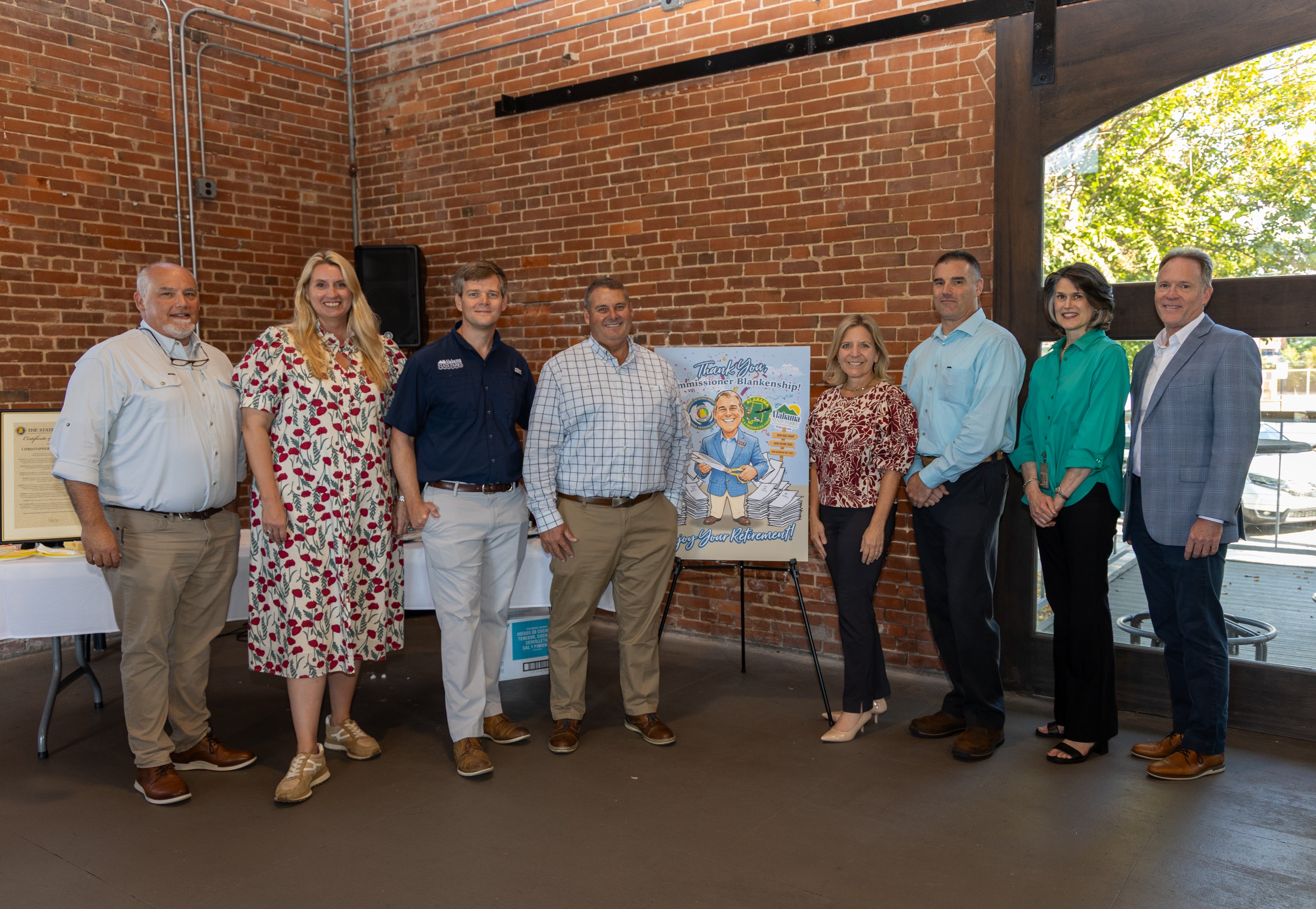
Chris Blankenship is joined by his top staff as his tenure as ADCNR Commissioner is celebrated. Photo by Kate Stone

By DAVID RAINER, Alabama Department of Conservation and Natural Resources

When Chris Blankenship was appointed Commissioner of the Alabama Department of Conservation and Natural Resources (ADCNR) by Governor Kay Ivey in 2017, the goals for the Department were somewhat modest. By the time he ended his nine-year tenure this week, ADCNR had utilized more than half a billion dollars to expand and improve the numerous opportunities to enjoy Alabama’s great outdoors.

Commissioner Blankenship remembers fondly his start with ADCNR in 1994 as a Conservation Officer with the Marine Resources Division (MRD).

“It has been a fantastic career,” he said. “When I got hired in 1994 as a conservation officer that was a fantastic job. They gave me a boat, a gas card and a vehicle to drive. They told me to go out on the water and talk to people. That was right up my alley. I really enjoyed it, and I felt like we really made a difference in protecting the resource. 

“I wrote a bunch of tickets the first couple of years, trying to get everybody’s attention, both on the commercial and recreational side. I think that made a difference. Word got around. I have a lot of good stories from those days. I think it changed the mindset on some people. They really straightened up.”

With what he called numerous good hires on the Enforcement Section, Commissioner Blankenship was able to move up the management side of Marine Resources, eventually becoming MRD Director. He was a trendsetter in that position as well.

“It was a bit challenging,” he said. “All of the Marine Resources Directors before me had been biologists, so someone from the enforcement side was definitely different. But it made me really learn a lot more about our overall operation. I think some of the skills I have are being able to build relationships, communicate with people, look at their perspective and be able to provide solutions to large-scale problems. It was not a difficult transition, but it did take a little bit of intentionality to learn more of the science side. We really have good people, so I relied on those people and the people at the University of South Alabama with Dr. (Sean) Powers to provide biological information that helps make management decisions. Those relationships are a key part of our success.”

From MRD Director, Commissioner Blankenship was asked to be Deputy ADCNR Commissioner by then Commissioner Gunter Guy, who was appointed by Governor Robert Bentley. 

“I had only been the Deputy Commissioner for three weeks when Governor Bentley resigned,” Commissioner Blankenship said. “It was a tumultuous time. I didn’t know if I was going to be retained by the new governor at all. I’m just very thankful that when Governor Ivey came in, she made me Acting Commissioner. A couple of months later, she made it permanent. I have really enjoyed working for her. She’s been a great boss and a good example of how you should lead large organizations like state government.

“The Good Lord definitely took care of me. I never anticipated becoming Commissioner. I never had that as a goal and really didn’t consider that a possibility. To start off as a conservation officer and end up Commissioner, sometimes I just sit there and think ‘Wow.’ I can’t believe how God has ordered my steps to put me here to be a good steward of what’s He’s entrusted us with, and I thank Him for his faithfulness.”

As an enforcement officer, Commissioner Blankenship said you can really impact only one person at a time. As Marine Resources Director and then Commissioner, he got to set policy for the agency that impacts hundreds of thousands of people and makes a real difference.

“That has been enjoyable seeing the growth and influence throughout my career,” he said. 

Chris

The Blankenship legacy will live on in numerous places, including the Blankenship Event Center at the Barnett Lawley Field Trial Area. Photo by David Rainer

The Commissioner said it’s hard to fathom all that has occurred in the past nine years in the state to protect and provide public access to Alabama's natural wonders, from the Tennessee River Valley and Appalachian Mountain foothills to the Gulf of America.

“Red snapper was a big issue at MRD and trying to get state management, working with the other states to determine the allocations,” he said. “Then working with our congressional delegation and President (Donald) Trump in 2017 to get state management as a pilot program and then a few years later working through the Gulf Council to make it more permanent. We went from a three-day season to a 200-day season. That was great for our coastal economy.”

Finishing the 350-room The Lodge at Gulf State Park in 2018 was another milestone with another huge boost for the state’s economy as well as a source of funding for work at numerous Alabama State Parks. The $85 million State Parks Bond Constitutional Amendment that overwhelmingly passed in 2022 has prompted improvements and expansion of outdoor recreational opportunities at Alabama State Parks around the state. The Commissioner will have retired but will attend as a visitor when the new lodge hotel opens at Cheaha State Park in two weeks at the highest elevation in the state.

“When Ed Poolos came in as Deputy Commissioner, we set some goals that I thought were going to be hard to attain,” Commissioner Blankenship said. “I told him we needed to stretch ourselves a little bit. We set out to spend $35 million in outdoor recreation improvements. That was our goal in 2018.

“To date, we’ve done $525 million in outdoor recreation improvements, so to say we met our goal and surpassed it is a massive understatement. Once we formed the partnerships, working with different cities, towns and counties, the dominoes just kind of kept falling where we could do this project here and that project there. We got some money from Innovate Alabama to do boat ramp work and trail work at Oak Mountain State Park and Coldwater Mountain. We passed the State Parks bond and put every penny of revenue from State Parks back into renovations. The Legislature provided $18 million over three years for outdoor recreation improvements. We used funds from GoMESA (Gulf of Mexico Energy Security Act) and the Deepwater Horizon Oil Spill for outdoor rec projects in Coastal Alabama. When you add it up, it’s more than a half a billion dollars in positive recreation work.

“We have also acquired more than 110,000 acres of land that will belong to Alabamians forever through Forever Wild, Wildlife and Freshwater Fisheries, funding from the Deepwater Horizon oil spill settlement, GoMESA and other partnerships. When you put all the funding together, it has really made a huge impact!”

Poolos was Deputy Commissioner for eight of Commissioner Blankenship’s nine years leading ADCNR. Poolos, who was named Director of the Alabama Department of Environmental Management last year, had nothing but praise for his colleague.

“Chris’s ability to maneuver through the bureaucracy of government to accomplish the lofty goals he set for the agency is what makes him special,” Director Poolos said. “His dedication to ensuring that future generations of Alabamians have access to the outdoors will be his lasting legacy. His devotion to the Alabama’s natural resources is unmatched.

“In my opinion, he will go down as the greatest Commissioner in the history of the Department of Conservation and Natural Resources.”

Commissioner Blankenship’s legacy will live on in other places as well. Governor Ivey named a large artificial reef zone in Gulf waters after him. The Town of Dauphin Island created the Christopher Blankenship Eco-Tourism Park. The Forever Wild Field Trial Blankenship Events Center was dedicated last year in Hale County.

Also, the University of South Alabama is creating the Blankenship Scholars Program to provide financial assistance for students who wish to pursue careers in law enforcement, from ADCNR to the U.S. Coast Guard.

“We have a group of great, passionate people in the Department of Conservation and Natural Resources, and I am thankful we have been able to facilitate whatever was needed for them to do good work,” Commissioner Blankenship said. “I think we have built a team and a culture that will continue this work for generations to come.  To me, that is what I call true success.”

Of course, many are wondering what’s next for Blankenship now that he is no longer Commissioner. He’s moving back home to Mobile to become the Executive Director of the Coastal Alabama Partnership, a group that provides leadership and guidance to achieve major initiatives for Mobile and Baldwin Counties.

###

snapper

Blankenship was instrumental is working to get red snapper management under state control. Photo courtesy of Chris Blankenship

Written by

David Rainer
Outdoor Writer
Back To News