From Range to Resources: A Cross-State Success Story

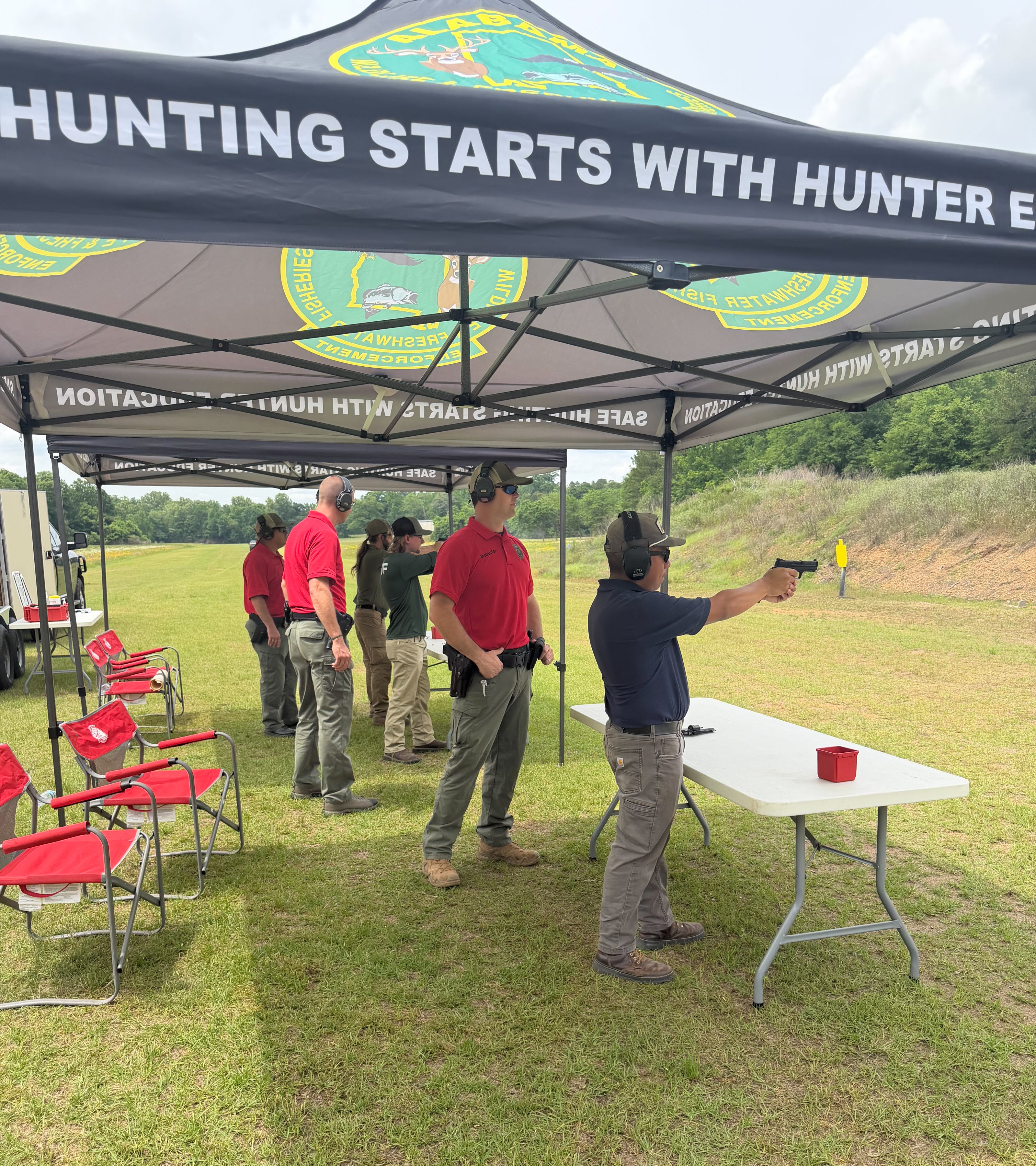
Louisiana Department of Wildlife and Freshwater Fisheries (LDWF) staff participating in a Firearms 101 class hosted by Alabama Department of Conservation and Natural Resources (ADCNR) Staff.

Louisiana Department of Wildlife and Freshwater Fisheries (LDWF) staff participating in a Firearms 101 class hosted by Alabama Department of Conservation and Natural Resources (ADCNR) Staff.

Alabama and Louisiana may be rivals on the football field, but off the field the two states are proving that conservation and public safety matter more than competition. Recently, staff from the Louisiana Department of Wildlife and Fisheries (LDWF) traveled to Alabama to learn more about the Alabama Department of Conservation and Natural Resources’ (ADCNR) Firearms 101 program with an end result that showed the value of sharing ideas, techniques and resources across state lines.

If you’re unfamiliar with Alabama’s Firearms 101 classes, ADCNR has an entire Shooting Sports Unit dedicated to firearm education, safety and public outreach. Matt Weathers, Law Enforcement Chief for ADCNR’s Wildlife and Freshwater Fisheries Division, explained that the unit oversees Alabama’s public shooting ranges and archery parks system while also developing and operating the Department’s shooting sports programs. 

To get a deeper look into the history and structure of the course, I spoke with Sgt. Ben Kiser, ADCNR’s District 2 Shooting Sports Coordinator.

“The Firearms 101 program began in late 2020 with an emphasis on providing safe firearm handling skills to our constituents,” Kiser said. “Firearms 101 is a four-hour class consisting of one hour of classroom instruction and three hours of range time. Students learn basic safe gun handling skills such as proper stance, grip, and other mechanics of target shooting before putting those skills into practice on the range.”

Since its launch, the program has continued to grow. Kiser shared that ADCNR’s Firearms 101 program has completed 206 classes and trained more than 2,200 students statewide. Of those participants, 68% were female and 60% were first-time license buyers. Statistics that demonstrate the program’s success in introducing new audiences to safe and responsible firearm use.

This success is exactly what caught the attention of Louisiana officials.

Jose Olivares, with LDWF’s Shooting Sports and Range Enhancement Team, explained that the partnership began during the Southeastern Hunter Education Conference in Baton Rouge. During the conference, LDWF staff met Lt. William (Bill) Freeman of ADCNR, who connected him with Sgt. Kiser and the ADCNR Shooting Sports Unit.

Olivares said LDWF staff were immediately impressed by the structure and organization of Alabama’s Firearms 101 program.

“Mr. Benjamin Kiser provided their flyers, handouts, and information on how they set their classes up,” Olivares said. “Through those discussions, the idea developed for ADCNR to help provide hands-on training and insight for LDWF Shooting Sports staff.”

ADCNR offered two options: bring Alabama’s mobile shooting trailer to Louisiana or host LDWF staff in Alabama for the full training experience.

“We took the opportunity to go to Alabama and get the full experience,” Olivares said. 

LDWF staff participating in Firearms 101 class.

From May 11 to May 13, Louisiana’s Shooting Sports and Range Enhancement Team trained alongside ADCNR staff, primarily at Shelby State Shooting Range. The final day also included tours of the Cahaba WMA Shooting Range and Oak Mountain Archery Park.

Josh Mann, ADCNR District 1 Shooting Sports Coordinator, explained that the beginning of the event was designed for LDWF staff to have the same experience those receive during a standard Firearms 101 course.

“The Louisiana team first went through a Handgun 101 class very similar to what the public sees,” Mann said. “However, insights into how and why we do certain things were incorporated throughout the training.”

During the training ADCNR instructors discussed teaching methods, material selection and adapting to different learning styles. On the range, LDWF staff practiced those techniques firsthand while also touring Alabama’s facilities and discussing future range development ideas.

Day two featured a Shotgun 101 course, followed by additional instruction involving a variety of shotgun and rifle systems. To finish the day off ADCNR staff also hosted the Louisiana team for dinner featuring local game, including venison and crappie.

For Olivares, one of the most impressive aspects of the training was the instructors’ ability to communicate with participants of all experience levels.

“One of the biggest takeaways from the collaboration was how effectively the ADCNR instructors communicated firearm safety and shooting fundamentals to students with different learning styles,” he said. “The simplicity of the instruction and the ability of the instructors to explain concepts in multiple ways made the material easy to understand and apply.”

He also commended the efficiency and professionalism of ADCNR’s shooting range setup.

“Before live-fire exercises began, the staff introduced us to their shooting trailer and demonstrated how quickly and professionally they could establish a safe and functional outdoor range,” Olivares said. “The setup included canopies, tables, chairs, and eye and ear protection already prepared, which created an excellent first impression and a welcoming learning environment.”

Mann said the exchange benefited both states equally.

“A concern that always comes with instructing any subject is the participant’s willingness to learn,” Mann said. “The Louisiana team definitely came ready to soak up as much information as possible. They remained engaged throughout the training and continuously contributed their own techniques and experiences. Despite this being a planned event to teach Louisiana conservation employees, we learned a lot from them as well.” 

LDWF staff participating in Firearms 101 class.

Chief Weathers believes partnerships like this are beneficial for the future of conservation and shooting sports education.

“The information and technique sharing that comes from events like this are immeasurable,” Weathers said. “Many agencies nationwide are developing programs like what Louisiana and Alabama have. Sharing ideas and success stories makes both agencies better able to tailor successful courses to their shooting sports constituency.”

For ADCNR, programs like Firearms 101, Hunting 101, Trapping 101 and others are about more than instruction, they are about supporting conservation and giving back to the communities that help fund and maintain Alabama’s natural resources.

“For more than a century, our department has protected the natural resource wealth of Alabama,” Weathers said. “The funds generated by the target shooting community provide a large portion of what is needed to protect and restore that wealth. Our Firearms 101 courses, along with our Public Shooting Ranges and Archery Parks, are one way we give back to those who do so much to support our conservation efforts.”

Author, Kate Stone

Written by

Kate Stone
Back To News