
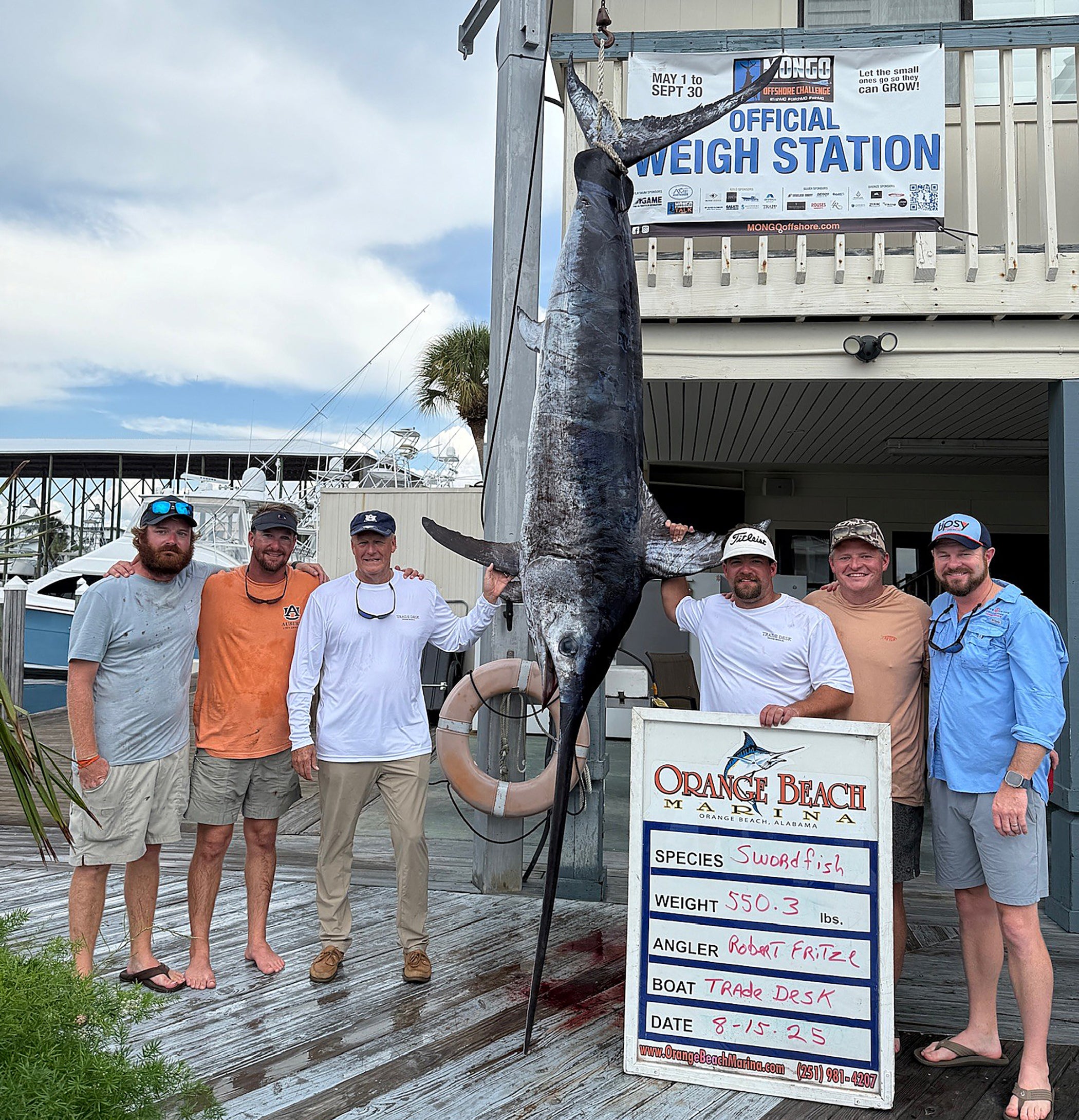
By DAVID RAINER, Alabama Department of Conservation and Natural Resources
When Trade Desk, a 60-foot Hatteras, left Orange Beach for three days of catch-and-release billfishing, hooking a swordfish was just an afterthought, one that would stress all their resources as well as enter the Alabama Saltwater Record Book.
Robert Fritze, his dad (Ron) and four buddies (Harold Wells, Jamie Boyd, Wes Hagler, Robert Parks) had scheduled the trip a while back for August 14-16 with the main goal of finding marlin and sailfish.
“We saw where people were having success catching blues, whites and sails,” said Fritze, who hails from Birmingham. “We headed out southwest and thought about deep-dropping, but that wasn’t the main goal, so we just decided to push on.”
The crew was near the Delta House oil and gas production platform in 4,500 feet of water when they discovered a rip (where two currents meet with distinctive color changes) that was not productive. They headed farther south and picked up a few dolphin (mahi mahi), a wahoo and several barracuda. They had a blue marlin follow one of the barracudas back to the boat, but it spooked and disappeared.
When the sun went down, they started jigging for tuna and put several blackfins in the tuna tubes for possible use as bait the next morning.
Because the offshore boat is not manned by a professional crew, the Fritzes and team took turns getting a little sleep.
“I took the first shift,” Robert said. “My dad came up to relieve me about one. I set a swordfish bait out, a regular nighttime setup with squid and a light.”
The bait soaked for quite a while before the big swordfish swallowed the squid.
“I grabbed the rod and got in the chair,” Robert said. “He was down about 300 feet when he bit. It took about 30 minutes until we saw the fish the first time. He was right at the edge of the spreaders. The bite was nothing special at that point. I could feel the weight, but it wasn’t like ‘Oh, my gosh.’
“Then he came back up, and I saw the bill coming out of the water, and it just kept coming. He got his head out of the water, but it wasn’t like he totally jumped. We got a pretty good profile of the fish, and my buddy, Harold, said, ‘That’s a tank.’”
The fish went down and came back to the surface two more times before it sounded.
“He peeled drag off for a good bit, and then it was a slow, steady going away,” Fritze said. “The drag was a tick, tick, ticking as he was going away. He was headed in the other direction, and there was no stopping him. We were looking at each other, and I was holding myself in the chair, and we were wondering if he was ever going to stop.”
As the line slowly stripped off the reel, the crew could tell the fish had descended to around 800 feet because of a marker on the braided line at that depth.
“Finally, he stopped, and I started getting a little ground on him,” Fritze said. “Then he would take it right back. At first, all I could do was get one full revolution on the handle. Finally, I started to get two or three revolutions, and he started coming to the boat. About halfway, he took a little run, but I slowly worked him back up.”