
Tactics Change for Late Season Turkey Hunting

sunrise

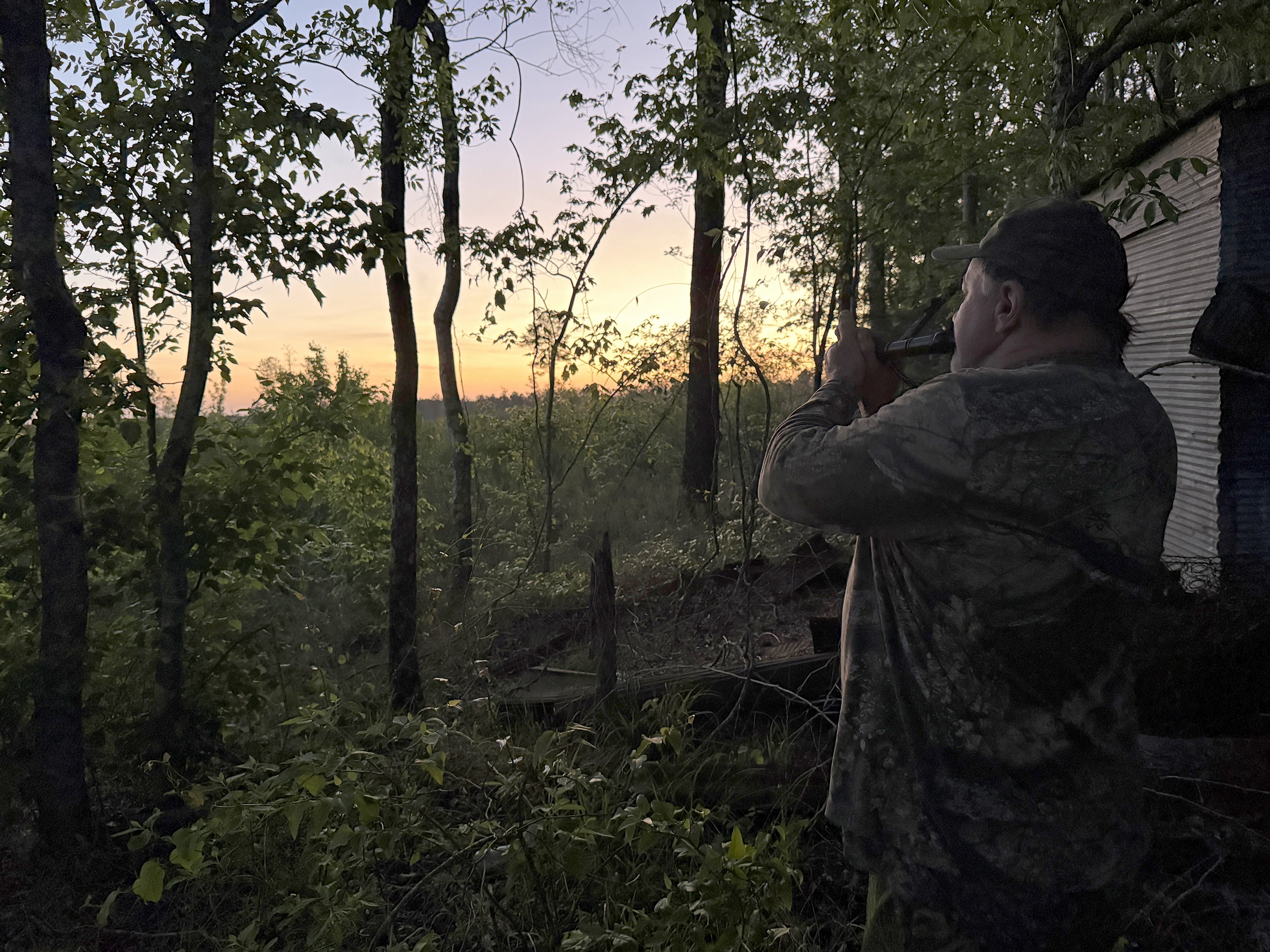
Larry Norton uses his owl hooter to try to locate a gobbler at sunrise in Choctaw County. Photo by David Rainer

By DAVID RAINER, Alabama Department of Conservation and Natural Resources

After three weeks of near perfect weather conditions, Alabama hunters have had significant success in the turkey woods this season with the usual stories of the birds that flew off the roost and came straight to the calling and those wary birds who got the best of the most seasoned hunters.

With the season nearing the midpoint, hunting tactics are about to need adjustment. The foliage in the trees is almost full, which means it’s going to be much harder to hear and pinpoint the gobbling. Plus, many of those 2-year-old gobblers eager to respond to calling have been reduced to bag.

I talked to two veteran turkey hunters about how turkey tactics will change for the remainder of the season. Corky Pugh retired as Director of the Alabama Department of Conservation and Natural Resources’ (ADCNR) Wildlife and Freshwater Fisheries (WFF) Division in 2011 and spends almost every morning of the spring turkey season in the woods. Larry Norton, a two-time World Champion caller, has chased turkeys in west central Alabama since he was old enough to hold a shotgun and was a guide at Bent Creek Lodge near Jachin and The Shed near Butler for 24 years combined. 

“It’s hard to separate from what turkeys themselves are doing compared to what we’re experiencing as hunters,” Pugh said. “When you hunt every morning like I do, you get tireder and tireder; plus, it’s getting lighter earlier every day. At the same time that’s happening to you, the turkeys are changing what they do.

“I don’t think there are any absolutes in turkey hunting. The only absolute is there are no absolutes. In generalities, what starts to happen is the hens start leaving the gobblers. That doesn’t mean all the hens leave all the gobblers all the time. When the hens start to disperse, that old gobbler that’s been surrounded by hens, all of a sudden all of his female companionship has left him. That may make him more vulnerable.”

Pugh said one of his turkey hunting mentors talked about a pause in gobbling activity around mid-season.

“He said turkeys go through a lull, and I think we’re in that lull about now when they don’t gobble much,” he said. “I can’t explain why that happens. As hunters, our memories are very selective. We remember the extraordinary hunts where the turkey is gobbling and strutting. And we tend to repress those less than pleasant days where we sat there in absolute stony silence.

“Another thing that happens is the turkeys get educated. Even on private land, every time you hunt, the turkey is learning about you and about calling. A messed-with turkey is a lot harder to kill than an unmessed-with turkey. The ultimate example of that is on public land. People who are willing to walk a quarter mile in the dark off a road can hunt a whole universe of turkeys that are unmessed-with. So many hunters are standing by the truck on the dirt road listening for a turkey.”

That situation is impacted significantly now that leaves have filled the trees to the top, muffling all sorts of sounds, including gobbling. “When the leaves get on the trees, you can’t even hear the turkeys from the road,” Pugh said. 

With the curtailed gobbling activity, Pugh opts to change his tactics by reducing the amount of calling and being patient.

“When I say getting back to basics, the way really good turkey hunters define basics is limited calling, sitting still and being patient," he said. "It’s not the gear you have; it’s patience and perseverance. Many of the turkey hunters I talk to say they are killing birds between 9 and 11, when everybody else has gone to get a biscuit. The second turkey I killed (this season) was at 11 o’clock…It was a very memorable hunt and memorable turkey.”

Pugh studied different father-son duos who have been highly successful turkey hunters through the years to pen his new book, “Turkey Tactics, A Guide to Tactical Turkey Hunting,” which is available on Amazon or at www.turkeyhuntingtactics.com.

Corky

Corky Pugh returned to his home county of Monroe to bag this gobbler recently. Photo courtesy of Corky Pugh

With permission from the author, Pugh uses a quote from Tom Kelly, the poet laureate of the turkey world, in his opening paragraph and preface to the new book.

Kelly wrote, “Turkey hunting is an outdoor tactical exercise that consists of a series of decisions, followed by a series of actions, most of which are irreversible. As a rule, errors compound themselves, and mistakes become evident some time after the fact.”

Pugh said, “I’ve never read a better definition of what turkey hunting is. What I tried to do in my book was glean from them (the father-son duos) basically how to turkey hunt successfully. That’s the core of the book with some personal experiences woven throughout and a good many quotes from Tom. Who knows more about turkeys and turkey hunting than Tom.”

Pugh said the best advice he can give someone is to pay close attention to what successful turkey hunters do.

“The common threads are remarkable,” he said. “One is stealth. One of them is patience. One of them is perseverance. One of them is paying attention to basics. If you do those four things, it doesn’t matter what time of year it is.

“Our tendencies as hunters is to focus on the auditory aspects of turkey hunting – gobbling, calling and all that. But that’s not their focus. Like all birds, they are visual creatures. Gobblers gobble to attract hens. Why is he doing that? He wants them to see him strut. That’s why sometimes gobblers stop gobbling. Once he’s attracted the hens, he just shuts up. Then you be patient and be patient some more.”

Norton, meanwhile, said one aspect that some turkey hunters might not consider is the use of decoys later in the season.

“Strutting decoys during the rest of the season is real iffy,” Norton said. “They work really well the first of the season when the gobblers are still working out the pecking order. Later in the season, like it is now, you’re liable to run off more turkeys than get to come to it. I just use hen decoys, and I like the feeding style with their heads down. I really don’t like the ones with their heads up that look like they’re alert.”

Norton also said the turkeys will likely shift locations this time of the season when the hens are starting to lay clutches of eggs.

“The gobblers are going to move closer to where the hens are nesting,” he said. “As soon as the hens fly down, they’re going to go off and lay. Some will actually start setting on the nest the last couple of weeks of the season. If you’re in an area and not seeing a lot of hens but you’re seeing a lot of dusting, it may mean the hens are already setting.

“Then the gobblers are going to be themselves. You can kill those turkeys late in the year, but they may not gobble good or at all. You may just hear them drumming. You have to get in areas where you’re seeing tracks and signs, and you have to be real patient.”

Norton said when the turkeys are not gobbling, he goes to places where he knows the turkeys have been.

“I set up and do a little calling and a lot of waiting,” he said. “One reason they may not be gobbling is there is an old turkey that has all the other turkeys whipped. They’re there but they just won’t gobble because they know that old gobbler is there. If a turkeys gobbles a couple of times on the limb and shuts up when he hits the ground, he’s just letting those other turkeys know he’s still around, and they need to keep their beaks shut.

Norton said during his years guiding at Bent Creek he often had to wait out a wise, wary gobbler.

“When that old turkey flew down and went off with his hens he would get out of hearing and my customer would ask what we were going to do now,” he said. “I told them we weren’t going anywhere. I explained to them that when that turkey leaves the area, the other turkeys will come to you, but they will just be drumming. I told them to be listening for drumming, and a lot of them didn’t know what that sounded like. I would point out when I heard it, and it would happen within the first 30 minutes because that bird is anxious to try to get to a hen before the other gobblers get there. 

“When that old gobbler has moved out of that area, I go back to where I’ve seen tracks and strut marks (scratches in the ground from the wingtips), set up and blind call. And when I do that, I really like being in a blind. You’re constantly having to look around. A turkey could walk up to 100 yards and spot you and you didn’t know they were in the world. So, it’s better to really be concealed good. I’m planning on sitting there for at least an hour. I’ve killed a lot of turkeys doing that. The blinds they have these days, you can open them up and be sitting in it in seconds. And I’ve got one of the 360 blinds where you can see out all the way around but the turkeys can’t see in. You can move around and change calls from a box call to a slate to a push button and you won’t get busted.”

The Alabama spring turkey season runs through May 8. Visit www.outdooralabama.com/seasons-and-bag-limits/turkey-season for more information.

###

tracks

When gobbling activity is subdued, successful hunters look for gobbler tracks and strut marks. Photo by David Rainer

Written by

David Rainer
Outdoor Writer
Back To News