
By DAVID RAINER, Alabama Department of Conservation and Natural Resources
If you have an Alabama saltwater fishing license or are on the saltwater registry, don’t be surprised if you get a call with a caller ID of the University of South Alabama (USA) or Alabama Creel, AL Creel for short. The Alabama Department of Conservation and Natural Resources’ (ADCNR) Marine Resources Division (MRD) has partnered with USA to conduct a portion of the AL Creel survey that provides the data needed for fisheries management decisions.
Kevin Anson, MRD Director, said the creel survey is very close to the survey methodology used by the Louisiana Department of Wildlife and Fisheries for its saltwater creel survey (LA Creel), which began in 2012. Anson hopes AL Creel will be accredited for official use by NOAA Fisheries, aka the National Marine Fisheries Service, just as LA Creel was accredited. This new effort is an extension of previous surveys done by MRD to determine the number of anglers and number of trips (effort) taken in Alabama waters and in the Alabama artificial reef zones.
“Actually, we have been doing the effort portion of the survey for a little while,” Anson said. “We were calling licensed anglers for their trip information on a weekly basis. We started that in 2024. Then in 2025, we continued the weekly phone calling of randomly selected anglers from our license list and added a dockside survey.”
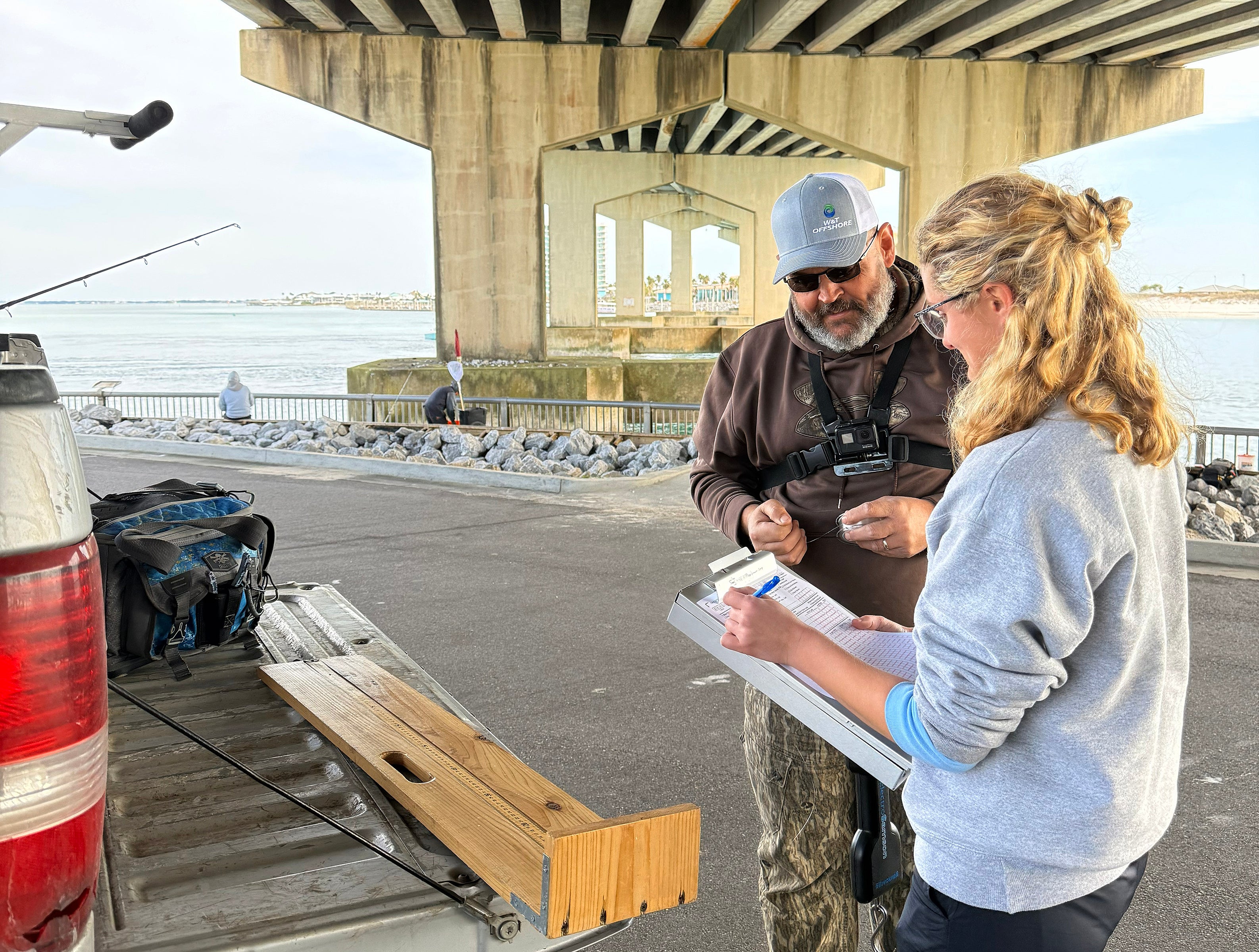
The dockside surveys are completed at publicly accessible boat ramps, marinas and shore fishing sites to get catch data from anglers.
“We multiply the estimated number of trips by the estimated catch from each of the different sampling areas and the modes of fishing,” Anson said. “We have it broken out by anglers fishing from boats, shore and state-licensed charter boats. We are not sampling federally licensed charter boats at this point. Those vessel landings are captured under a separate federal program.
Anson said AL Creel is being implemented side by side with NOAA Fisheries’ federal recreational angler survey in order to compare estimates.
“We are still conducting the federal dockside survey to get the catch information they need to go with their effort information that they collect through a mail survey. They send out effort surveys asking about trip information over a two-month period.”
Anson said, although NOAA compensates MRD for doing the dockside survey, it is a drain on MRD resources. He hopes the AL Creel survey will replace the federal surveying effort.
“The two-month period to recall fishing trip information is reduced to 12 days in AL Creel, so it is believed this will reduce errors associated with recall,” Anson said. “In addition, AL Creel contacts the licensed anglers by phone whereas NOAA primarily uses a mailing list of valid post office addresses.
“Until we can get the AL Creel survey certified by NOAA as a statistically valid means of gathering recreational fisheries data, it causes us to have more folks in the field doing both programs,” he said. “It’s also burdensome on the anglers to get questions from two surveys. Hopefully, we can make that transition this year.”