
By DAVID RAINER, Alabama Department of Conservation and Natural Resources
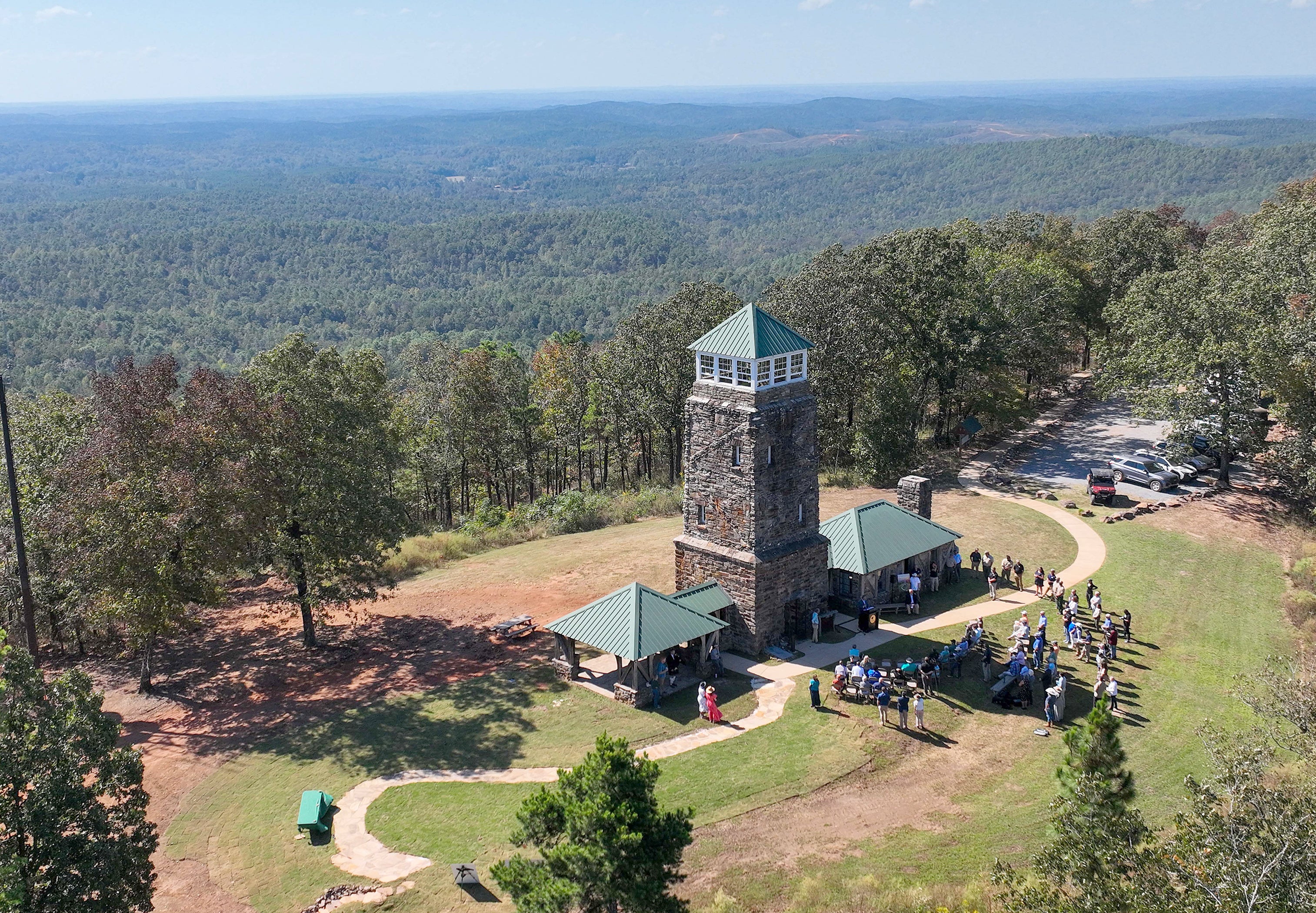
Alabama’s Flagg Mountain was officially opened last week as the southern terminus of the Pinhoti National Recreation Trail, which features 171 miles of the trail in Alabama. It provides hikers access to the natural wonders of the state as it retraces the route taken by untold numbers of Native Americans and early settlers.
Last week’s opening was marked by a ribbon-cutting ceremony at the historic fire tower atop the mountain as members of the Alabama Trails Foundation, Alabama Forestry Commission, Alabama Department of Conservation and Natural Resources (ADCNR), Alabama Tourism Department, state legislators and other dignitaries gathered to celebrate the renovations made to the facilities on Flagg Mountain’s 1,156-foot summit.
“We were celebrating the collaboration between the Alabama Trails Foundation and the Alabama Forestry Commission and all the work that was done on the tower at Flagg Mountain,” said Paul DeMarco, Alabama Trails Foundation President. “Also, we were kicking off the fact that the gateway to the Pinhoti Trail is at Flagg Mountain.”
Conservation Commissioner Chris Blankenship said the Pinhoti Trail is a true treasure for Alabama.
“From the beginning at Flagg Mountain, the Pinhoti traverses adjacent Forever Wild property, passes through Cheaha State Park, and continues through some breathtaking parts of Alabama to the Indian Mountain Forever Wild Property near the Georgia line,” Commissioner Blankenship said. “It is truly a special trail and the most recognizable long trail in Alabama.
“As the chairman of the Innovate Alabama Outdoor Recreation Council, I was glad to be a part of investing more than $1.5 million for upgrades to the trail infrastructure. The water line at Flagg and a new restroom facility at the Cheaha Trailhead are just two of the projects that will make the Pinhoti better for the thousands of through hikers who utilize the trail annually.”
The Civilian Conservation Corps (CCC) built the Flagg Mountain stone tower used for fire lookout as well as several cabins in the 1930s. The tower construction included 3-foot-thick stone walls at the base and 2-foot walls all the way to the observation room. The tower was listed on the National Historic Lookout Register in 1998. The Forestry Commission has been renovating the tower and surrounding structures for the past several years, allowing visitors to climb the tower stairs to catch a panoramic view of Alabama’s beautiful Appalachian foothills.
Flagg Mountain, located in the Weogufka State Forest, is owned by the State of Alabama and managed by the Alabama Forestry Commission. Weogufka State Forest is home to some of the state’s few remaining old longleaf pine forests. Since 1989, Weogufka State Forest has been listed in the Alabama Register of Landmarks and Heritage by the Alabama Historical Commission.
Including the Alabama segment, the Pinhoti National Recreation Trail covers some 350 miles in total and ends in northwest Georgia, where it connects to the Benton MacKaye Trail, which connects to the world famous Appalachian Trail. The Alabama segment of the Pinhoti is broken into 13 sections.
“Flagg Mountain is the starting point,” DeMarco said. “The exciting part is we’re celebrating the highest peak of the Appalachian Mountains in Alabama. We consider it the gateway to the Appalachian Mountains, starting right there at Flagg Mountain in Coosa County, Alabama. The Alabama Pinhoti goes through Coosa, Talladega, Calhoun and Cleburne counties and ends just across the line in Georgia.
“We put a brass marker down (at Flagg Mountain) that reads 0.0. The Appalachian Trail officially starts at Springer Mountain in Georgia, but if you really want to hike all the way to Maine, you’ve got to start in Alabama, and that’s what we’re excited about.”