
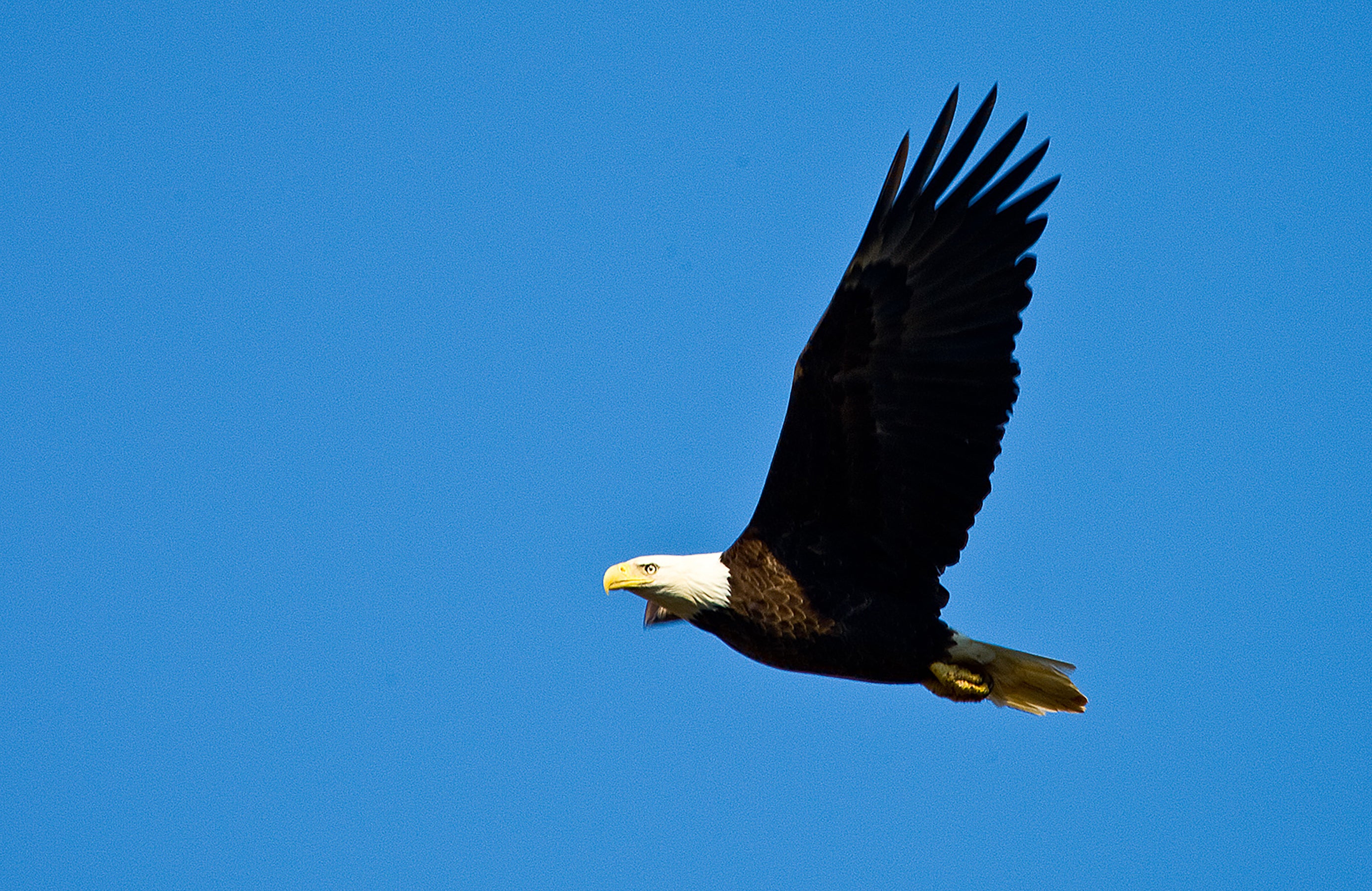
By DAVID RAINER, Alabama Department of Conservation and Natural Resources
An overflow crowd is expected to celebrate the 40th anniversary of Eagle Awareness Weekends at Lake Guntersville State Park in January, and no one will be more excited about this achievement than Linda Reynolds and Renee Raney.
Reynolds was the first naturalist at Lake Guntersville State Park and a trailblazer who, with the help of volunteers, organized the first Eagle Awareness Weekend in 1985. That inaugural event was a life-changing experience for Raney, who attended as a college student from Jacksonville State University.
The Eagle Awareness Weekends are set for January 23-25, 2026, and January 30-February 1, 2026, at Lake Guntersville. Visit www.alapark.com/EagleAwarenessWeekends and click on the link to reserve a spot for a package holder, which includes lodging, several meals, all of the presentations and all of the guided tours during the event. Space is limited. Check back online in December for the availability of day passes.
Raney, Alabama State Parks’ Chief Naturalist, said she came to an Eagle Awareness Weekend when she was 18; it was one of the first conservation education programs she engaged with as a university student.
“It was part of the reason I chose a career in environmental education and conservation,” Raney said. “I have literally been involved in Eagle Awareness for 40 years, either as an ornithology tour guide, a presenter or, now, as a coordinator. It’s really exciting for me to see this 40th year of existence. Alabama has had a great success story with this endangered species. Not only did Alabama State Parks care, but basically the entire country cared to send representatives and guests to Lake Guntersville State Park to support this program.”
Alabama State Parks Director Matthew Capps provided praise for the State Parks staff, the naturalist team and volunteers who have made it possible for Eagle Awareness Weekends to continue to thrive into their 40th year.
“It’s a great achievement that our Eagle Awareness Weekends will reach a milestone like this and celebrate our national bird, the bald eagle,” Capps said. “Alabama State Parks thanks all those who contributed to making these weekends such a success.”
The history of eagles in Alabama, especially bald eagles, is truly a remarkable recovery story. Conflicts with humans in the late 1800s and early 1900s left the eagle population decimated. The Bald Eagle Protection Act of 1940 provided civil penalties for those who "take, possess, sell, purchase, barter, offer to sell, purchase or barter, transport, export or import, at any time or any manner, any bald eagle ... [or any golden eagle], alive or dead, or any part (including feathers), nest, or egg thereof."
Another setback for the eagles occurred with the introduction of DDT insecticide, which caused damage to eagle nesting success. DDT was finally banned in 1972, but by that time, the eagle population had plummeted to about 1,000 birds. The U.S. Fish and Wildlife Service listed bald eagles as endangered in 1967.
The Alabama Department of Conservation and Natural Resources’ (ADCNR) Wildlife and Freshwater Fisheries Division created its Nongame Wildlife Program in 1982, and it became a part of a multi-state effort in the Bald Eagle Restoration Program in 1984. Mercedes Maddox, WFF Nongame Biologist, who is one of the presenters during the Eagle Awareness Weekends, said Alabama used a technique called hacking to help the population rebound. Hacking is where the biologists force an immature bird to take its first flight in a desired area. Eaglets from Florida and Alaska were released at specific locations with depleted populations. The goal was for the eagles to imprint on those areas and return when they became sexually mature.
The first eagle to take flight from one of the hacking towers occurred in 1985 at Lake Guntersville. The first documented nest success occurred in 1991, and the efforts have been so successful that Alabama has eagles in all 67 counties in the state.