
By DAVID RAINER, Alabama Department of Conservation and Natural Resources
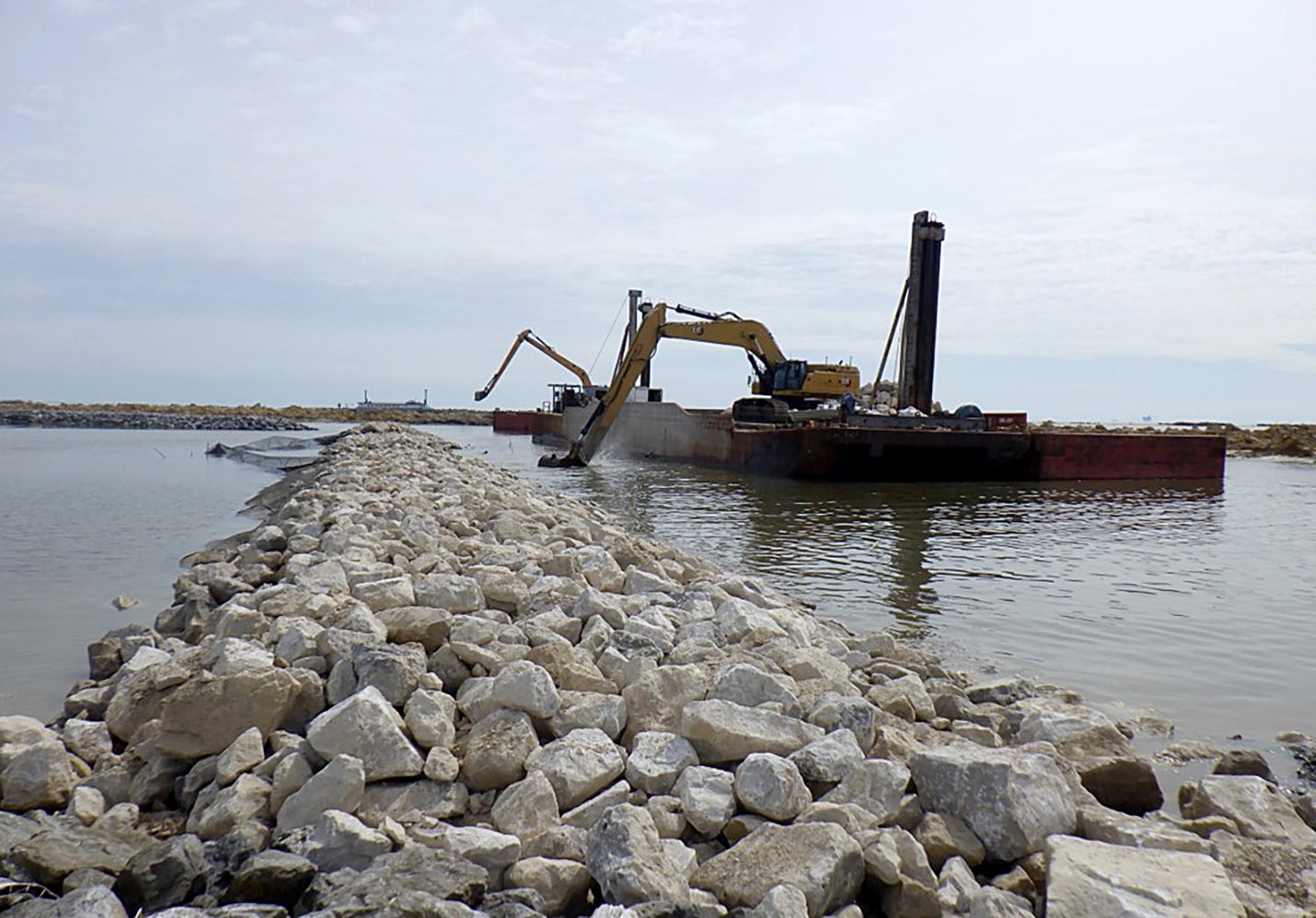
If you’ve traveled to Dauphin Island in the past two years, you’ve obviously noticed all the work that’s ongoing along the Dauphin Island Causeway. Rows of riprap, piles of dredge material and heavy equipment dot the east side of the roadway for more than 3 miles.
The Dauphin Island Causeway Shoreline Restoration Project is being done in three phases to enhance and protect the only access road from Dauphin Island to the Mobile County mainland.
Phase 1 included building segmented breakwaters with the rock along 3-plus miles of the Causeway, with the northern section running from Bayfront Park to Jemison’s Bait Shop and the southern section from Heron Bay Cutoff to Cedar Point.
Phase 2 includes taking dredge material from work being done on the Mobile Ship Channel and the turning basin and placing it between the Causeway and breakwaters. A sand berm will also be constructed next to the breakwaters for additional containment and a mimicking of the natural habitat.
Phase 3 includes planting native grasses and creating tidal creeks after the marsh platform is established. The gaps in the breakwaters will allow tidal flow and provide nursery habitat for species like shrimp, crabs and a variety of fish species. The vegetation is expected to take three to five years to become fully established.
The U.S. Army Corps of Engineers did a preliminary report in 2004 that indicated work needed to be done to protect the Causeway because of its vulnerability to tropical storms, from depressions to full-blown hurricanes. The roadway was typically flooded and sometimes washed out during the storms. The Mobile County Environmental Services started working with Alabama Department of Conservation and Natural Resources (ADCNR) Commissioner Chris Blankenship and the Mobile Bay National Estuary Program back in 2018 to start the restoration process.
“The community has been aware of this problem, and we’ve been trying to come together to get the resources to restore it for more than 20 years,” said Tina Sanchez, Mobile County Environmental Services Director.
After the National Fish and Wildlife Foundation (NFWF) approved Mobile County’s proposal for funding the start of the project, work began on the breakwater system, completed in 2024. The breakwater system protects from wave action and contains dredge and other material that will be placed between the Causeway and the breakwaters to establish a living marsh.
“Right now, this is the exciting time,” Sanchez said. “I think it’s important to talk about the beneficial use of the dredge material. The U.S. Army Corps of Engineers is placing material from the dredging of the ship channel on-site to restore about 100 acres of marsh.
“This would not be possible without multiple partnerships and the beneficial use program (dredge material) moving forward. We couldn’t have done this without the beneficial use material by the U.S. Army Corps of Engineers. We got it for a dollar per cubic yard. If it hadn’t been available, and if the Corps did not place it themselves, I don’t know if this project would be possible. The availability of the material at a low cost was the key component of this project moving forward.”
The marsh habitat will be restored all the way to Cedar Point with the exception of Heron Bay Cutoff. Placing the dredge material should be finished by late fall this year.
“This is a great example of a project that benefits the ecosystem and community resilience factor,” Sanchez said. “The shoreline stabilization protects the newly restored marsh, but it also protects the road that is the only way in and out of Dauphin Island. And, importantly, it also protects the 200 to 300 acres of marsh to the west of the Causeway. It’s also critical habitat for the critters we love to catch and eat, and it’s buffering from storm surge. It’s a mitigation project for coastal hazards and to protect the environment.”